

2018 Camino San Salvador
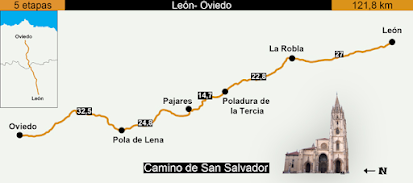
On May 5th, I flew to Madrid with my son Bas to hike the Camino San Salvador together. It is a route—reputedly beautiful and mountainous—spanning approximately 120 km from León to Oviedo, with a peak elevation of 1,572 meters. The towns and villages we hope to encounter along the way include León, La Robla, Pajares, Pola de Lena, Mieres, and Oviedo. It is a region where it rains frequently—especially during April and May—so we are hoping for some decent weather and the chance to wear our sunglasses now and then.
This route does not lead to Santiago de Compostela. There is a Spanish saying: "Quien va a Santiago, y no a San Salvador, sirve al criado y olvida al Señor," which translates roughly to: "He who goes to Santiago but not to San Salvador visits the servant and forgets the Master." This is an ancient route. When the Moors advanced northward through Spain, many sacred relics from religious communities in the south were sent north for safekeeping. Many of them ended up in the Catedral del Salvador in Oviedo. Undoubtedly encouraged by the local authorities, pilgrims were urged to visit the cathedral of their Savior in Oviedo first before continuing their journey—usually via the Camino Primitivo—to Santiago de Compostela.
.
05-05-2018 - to Leon
We set off early again to be at Schiphol by 6:00 AM. The roads were wonderfully quiet, so we arrived in good time. We flew with Iberia Express—something we won't do again, as there is far too little legroom. Standard Iberia or Transavia is fine, but I wouldn't choose Express again if you're taller than 1.85m. Upon arrival at Madrid airport, we bought a ticket for the train to Madrid-Chamartín, where our high-speed train to León was scheduled to depart. We had been sold a ticket for the 2:10 PM train—three hours away—even though the 11:48 AM train was still sitting at the platform. We quickly exchanged the ticket and boarded the train to León. Traveling at 250 km/h by train is quite an experience if you’ve never done it before; it really moves! In León, we took a leisurely walk to the albergue. It was already quite warm there compared to the Netherlands.
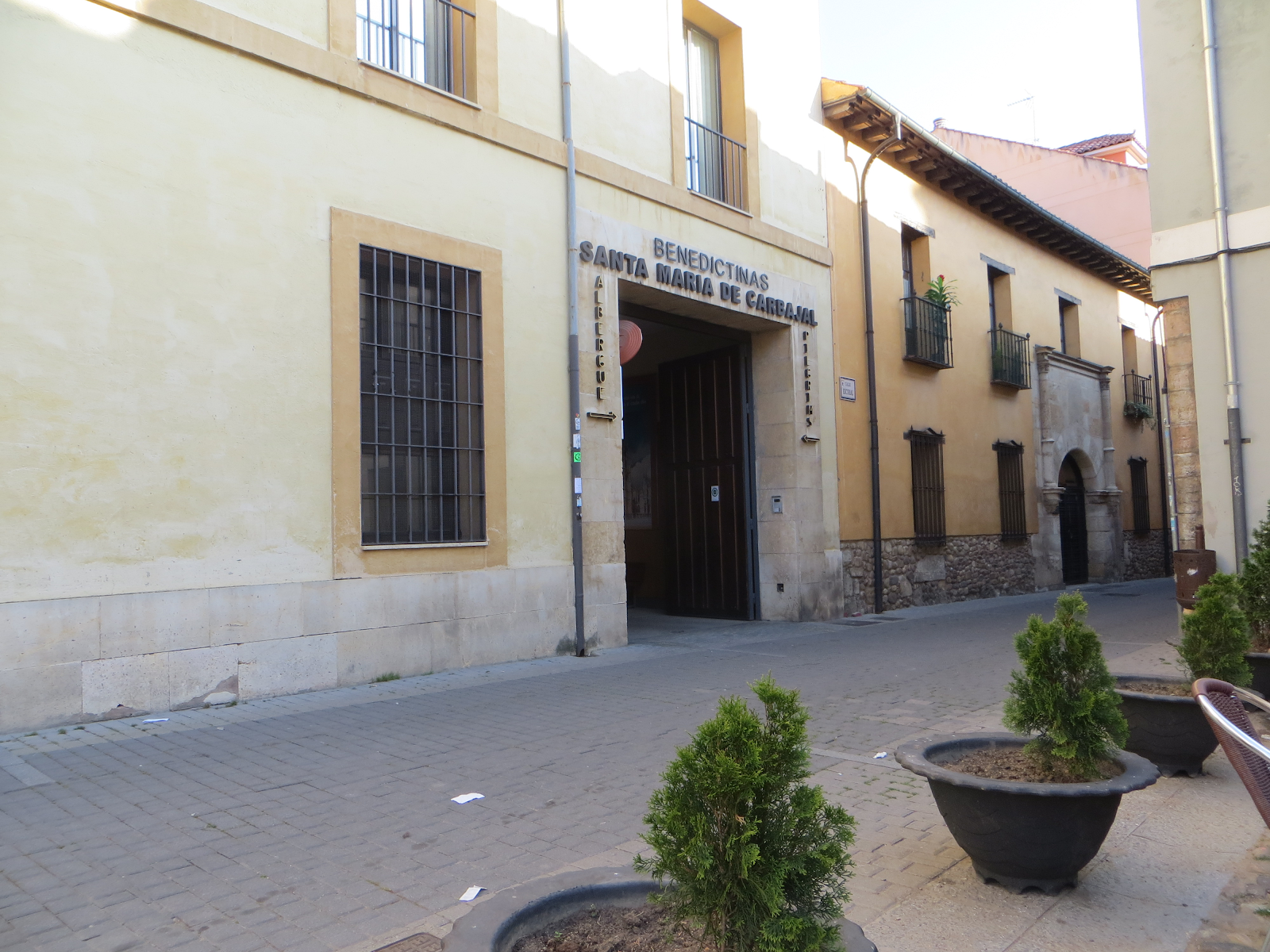
At the albergue, we bought a credencial (pilgrim's passport) for the Camino San Salvador; we use a different one here than for the Caminos leading to Santiago. We’re staying in a room with 18 beds, and we estimate there are just under 100 people staying in the building in total. In the evening, we grabbed a bite to eat at a restaurant in León and ordered a large steak to share. We went to bed early after that, knowing we’d be up early the next morning. The rustling of backpacks and shuffling toward the sinks would likely start early, as most people here are walking the Camino Francés and tend to start their day early. It was quite warm during the night due to the number of people and the fact that all the windows were closed. Despite all that, we still managed to get a good night's sleep!
06-05-2018 - to La Robla
27 km
The next morning, thehospitalero woke us up, though I think everyone was already awake; as I mentioned, the early risers had gotten up an hour and a half before, making plenty of noise rustling plastic bags and moving about. Many had already left, using flashlights to guide their way. After a simple breakfast at the *albergue*—a few crackers and a piece of baguette with a hot liquid they called coffee—we set off and walked to the spot in León where the Camino Francés and the Camino del Salvador diverge. Shortly after, we took a dirt path along a river that eventually turned into a gravel track. Small hills soon gave way to steeper inclines. Along the way, we met two other walkers—an Italian man and a German woman walking together—but otherwise, the trail was deserted; this route isn't heavily traveled. We walked alongside a river all day, and whenever the path climbed a bit, we enjoyed beautiful views of the landscape. We passed very few villages on this first day, and the ones we did see were deserted; there wasn't a soul to be seen on the streets this Sunday. Perhaps everyone was still in bed catching up on sleep—it’s Mother’s Day here today, a week earlier than back home. Upon arriving in La Robla, we headed straight for the albergue, a nice, clean building at the edge of town—a village characterized by industry and mining. It was a pleasant little albergue where a Spanish cyclist helped us call ahead to the next stop; if you don't call, they don't expect you, and you won't get dinner. Later, an older man named Patrick arrived—an Irishman in his early seventies—and we ended up having a lovely dinner outdoors with him on the village square that evening. It had been a beautiful, gently rolling route with pleasant weather, and we wrapped up the day nicely with dinner on the terrace.
07-05-2018 - to Poladura de Tercia
25 km
There were eight of us hikers, and there’s always someone who snores, but we slept soundly that night. We got up at 6:30, washed up at a leisurely pace, and then had breakfast. We had a baguette and a tin of tuna with us; it was tasty enough but a bit dry—hard to get down. Maybe next time we should bring some tea or instant coffee. After five trips to the toilet—likely due to last night’s steak and the olive oil, which doesn't agree with me—we finally set off at 7:45. Leaving La Robla meant following a long, straight road until the turnoff for Buiza and the Camino Montaña. The climb began almost immediately after that. The weather was beautiful, and we were already sweating profusely on the asphalt road, which radiated the heat. Further along, the surface changed to loose gravel, and the path shot steeply uphill. There were stunning views of snow-capped mountains—the foothills of the Picos de Europa. By the end, we had climbed quite high, and the path turned into a narrow ledge along the mountainside that we had to traverse. Since we both suffer from a fear of heights, it was a struggle; we just tried looking the other way. We were at an altitude of 1,460 meters—beautiful up there, certainly, but it was a relief to start heading back down. Upon arriving at the *albergue* in Poladura de Tercia, we decided to get a room at the adjacent *Casa Rural* instead. The *albergue* didn't look appealing; it was a bit dingy, bare, and cold. A short while later, as we were waiting for the owner, the Irishman walked in. He had booked a room there too. That was a nice surprise! We had a pleasant dinner together in the evening and went straight to bed after coffee, as tomorrow promised to be another grueling day involving a climb to over 1,500 meters within the first 5 kilometers. It was a beautiful day, offering sweeping views and snow-capped mountain peaks. It was striking how much water was flowing down from the mountains, even though there wasn't all that much snow left on them. Bas had some stomach pain after dinner today; let's hope it’s gone by tomorrow.
08-05-2018 - to Pajares
16 km
I slept reasonably well last night and was up early again. The hospitalera—who also owns the Casa Rural—had set everything out for breakfast so we could help ourselves without her having to get up so early. She lived in the house next door, so it wouldn't have been far if she had needed to come over anyway. During breakfast, we realized we hadn't received a stamp for this village in our *credencials*. Usually, these stamps are kept under the bar; after a thorough search, we found the right one. Problem solved. We set off at a quarter to eight. Bas’s stomach pain had subsided a bit, and he was feeling somewhat better. The weather was beautifully clear, though quite chilly. We knew we’d warm up quickly, as the trail headed uphill immediately after leaving our accommodation. We were entering wolf and brown bear territory; a large population of brown bears lives here in the Cantabrian Mountains of Castile and León, occasionally making an appearance. It’s not entirely without risk, as they are quite large animals. Perhaps we’d even spot one. The path kept climbing steadily; fortunately, the clear weather offered great visibility, providing stunning views of the Picos de Europa and snow-capped mountains all around. After a while, we reached the Crucero de San Salvador at 1,448 meters, and a little further on, we were actually walking through snow. At first, it was just small patches covered in about 30 cm of snow, but higher up—at 1,572 meters on Canto la Tusa—we encountered larger, longer stretches we had to cross. The sky clouded over very quickly, and visibility dropped to almost zero. We shuddered at the thought of walking this stretch in heavy rain or a thunderstorm. There was nowhere else to go from there. After reaching the summit, the path naturally led back down—a steep 500-meter descent right away. Great for the knees. Once at the bottom, we headed straight to the *albergue* in Pajares—a tiny village—where we were welcomed by Marisa, our cook for the evening :-). It was a decent albergue: clean and with plenty of showers. All in all, it was a beautiful route today, involving a lot of climbing. We enjoyed stunning vistas and even walked through the snow. There were no opportunities for coffee or anything similar along the way, so we had to carry everything with us. It’s best to call Pajares in advance to let them know you’re coming so they can buy food for you; there’s nothing available to buy there. We didn't see any brown bears.
09-05-2018 - naar Herías (Bandueños)
Today’s walk wasn't supposed to be long, and it was meant to be all downhill—or at least on flat ground. That turned out not to be the case at all. The first kilometer dropped sharply, followed by a five-kilometer climb. We had taken a wrong turn, of course, though in hindsight, it saved us from an even bigger extra hill. The route consisted of narrow farm tracks—goat paths, really—winding up the mountainside. We often had to cross farmyards guarded by large dogs and pass through gates to walk across their fields. Fortunately, the dogs were still too sleepy to react much. You see these dogs in the pastures with the livestock, too; they are placed there to guard the herd and protect it from local wildlife like bears and wolves. So, we had expected flat terrain, but that wasn't the reality. It was a tough day, but a beautiful one! The scenery was stunning, with lovely vistas—even here, now that we weren't walking along the mountain peaks—and everything was beautifully green at this time of year. Upon finally arriving in Herias, we had to head to the *albergue*, which was—naturally—located a kilometer and a half outside the village. You guessed it: uphill, and a steep climb at that! Panting and with my T-shirt soaked in sweat, I finally reached the Santuario de Bandueños in Herias. It was a church with a small building opposite it (think small bungalow) offering eight beds for pilgrims. It was still closed, of course, even though our arrival had been announced. We called Sandra, the *hospitalera*, and she soon came up the hill to unlock the door. It was a lovely little building with eight beds, showers, toilets, a small back terrace, and a kitchenette—in short, it was wonderful. We didn't regret coming here at all. She was going to cook dinner for us that evening. Patrick the Irishman was expected to arrive too, and an American also showed up and ended up spending the night. It was a lively atmosphere, and everything was *donativo*—pay whatever you think it’s worth! The food was a bit of a letdown: a hearty soup with chorizo and white beans. Not really my favorite. Plus, there wasn't much meat in it because—or so she claimed—if there were too much meat, we’d consume too much protein and wouldn't be able to sleep.
Strange folk, those Spaniards.
10-05-2018 - to Mieres
26 km
We slept very well on good mattresses—probably because we hadn't eaten much meat yesterday :) Today’s route was flat and just over 25 km long; it was quite manageable since there were no mountains involved. After packing our backpacks and having a few cookies for breakfast, we set off. The weather was drizzly—neither quite raining nor quite dry. We put on our rain jackets; after all, we hadn't brought them for nothing! Patrick, the Irishman, joined us, and the three of us headed down the hill. We soon took a wrong turn towards Campomanes; you always seem to pick the wrong path at a three-way junction! Eventually, we found the right turn and carried on. It didn't really matter, though, because the scenery here is beautiful everywhere, provided you're heading in roughly the right direction. In Pola de Lena, the three of us enjoyed a nice breakfast. It’s amazing that three breakfasts—including coffee, fruit juice, and tortilla or toast—cost only €7. Anyway, with our bellies full, we moved on. Today’s route was more urban, involving a lot of paved roads and passing through villages. We also walked alongside a road and a river for the entire day—a nice change of pace! Upon arriving in Mieres, Patrick headed to his hotel while we sought out the *albergue*. It was a building next to a church; we had to call someone to come over with the key. Within five minutes, a grumpy man arrived to check us in and hand us the front door key. After that, we found a bed, had a nice shower, and washed our clothes. A small café attached to a hostel and restaurant was located just 500 meters further along the route. In front of this little café, there were a few tables where I am now happily writing this story with a glass of wine, sitting in the sun.
11-05-2018 - to Oviedo
16 km
For a change, the sun was actually shining this morning, though it was quite chilly. It was set to be a day covering relatively few kilometers, passing through urban areas and into Oviedo. We faced two decent climbs and one smaller one just before entering the city. The first climb appeared right after we left the albergue. The three of us walked together all day; Patrick joined us again—a delightful man who, despite being 72, kept up with us easily. The landscape was beautifully green—something that really stood out. It has been quite damp lately, so everything is growing vigorously. The two hills were a fair climb, but unlike previous days, there were plenty of cafés along the way where we could sit for a while. From the second hill, we had a great view of Oviedo, with just one final small rise to cross before entering the city. Upon arriving at the albergue in Oviedo, we immediately encountered other pilgrims walking the Primitivo—the Camino route from Oviedo to Santiago de Compostela. We didn't need to stay there, though; we had booked a hotel next to the cathedral. We headed straight to the cathedral to collect our Salvadorana—a commemorative document issued by the church to mark this journey. A nice keepsake for the future. Afterward, we took a look around the cathedral and finished the day with a beer in the square.
It was a magnificent Camino. Beautiful scenery and stunning mountains at impressive altitudes. We thoroughly enjoyed it! Yet, it is a journey that requires some preparation. You can't simply set off on this Camino without planning; you need to do your homework regarding where to eat in the evening, where to withdraw cash, and where to spend the night, given the relatively limited number of albergues. You will also need to consider whether—and how much—food to bring for a day or two, as food isn't always available everywhere. You will need to adjust your clothing choices based on the season, as there is a chance you might encounter snow or face several days of rain, meaning washed clothes won't dry. We didn't see a tumble dryer in any of the albergues! But once all that is sorted out, you’re in for a wonderful hike spanning four, five, or six days.